

Yes, you can refinance your mortgage without a property appraisal, and for many Utah homeowners in 2026, it’s the faster and more affordable path. Three government-backed programs skip the appraisal requirement in most qualifying cases, and conventional loans can qualify through automated underwriting systems that issue appraisal waivers when your equity and data meet the threshold.
The main no-appraisal refinance options available to you:
- FHA Streamline Refinance: For existing FHA loan holders; usually skips appraisal, income verification, and credit check in most cases
- VA IRRRL (Interest Rate Reduction Refinance Loan): For eligible veterans and active service members refinancing an existing VA loan
- USDA Streamline Refinance: For rural homeowners with a current USDA loan who meet program eligibility
- Conventional appraisal waiver: Granted through Fannie Mae’s Desktop Underwriter or Freddie Mac’s Loan Product Advisor when you have sufficient home equity
Skipping the appraisal can save you appraisal fees and processing time, though some no-appraisal loans carry a slightly higher interest rate to offset lender risk.
Why lenders require appraisals during a refinance
A refinance appraisal is an independent assessment of your home’s current market value, ordered by your lender early in the underwriting process. The appraiser visits the property, reviews comparable sales nearby, and delivers a written report that becomes the basis for your loan terms.
Lenders use appraisals as a core risk-management tool. Before approving a refinance, they need to confirm the home is worth enough to serve as collateral for the new loan. If you default, the lender needs to recover its investment through the property, and an inflated or unknown value puts that recovery at risk.
Common reasons a lender orders an appraisal:
- To calculate your loan-to-value (LTV) ratio, which drives your rate and terms
- To determine whether you need private mortgage insurance (PMI)
- To set the maximum loan amount on a cash-out refinance
- To verify the property’s condition hasn’t deteriorated since the original purchase
- To comply with investor guidelines from Fannie Mae, Freddie Mac, or government agencies
In 2026, Utah’s housing market remains active, and lenders are paying close attention to local value fluctuations. When automated data is thin or a property is unusual, lenders revert to a full appraisal regardless of your credit profile.
Loan programs that let you refinance without an appraisal
Not every refinance requires a licensed appraiser to walk through your home. Several programs are specifically designed to cut that step.
FHA Streamline Refinance is available to homeowners who already have an FHA loan. In Utah, FHA streamline refinances typically require no appraisal, no income verification, and no credit check in most qualifying cases. The goal is a faster, lower-cost path to a better rate on an existing government-backed loan.

VA IRRRL serves veterans and active-duty service members who want to lower the rate on an existing VA loan. The program generally waives the appraisal requirement, and the VA IRRRL and USDA streamline programs are both built around the idea of refinancing efficiently when eligibility is already established.
USDA Streamline Refinance works the same way for rural borrowers holding a USDA loan. No new appraisal is typically required as long as you are current on payments and the refinance produces a measurable benefit.
Conventional appraisal waivers are a different mechanism. Fannie Mae’s Desktop Underwriter and Freddie Mac’s Loan Product Advisor analyze your loan data and, when confidence is high, issue a waiver. These systems generally require sufficient home equity to approve the waiver.
| Loan Program | Appraisal Required? | Key Eligibility Criteria |
|---|---|---|
| FHA Streamline | Usually no | Must have existing FHA loan; net tangible benefit required |
| VA IRRRL | Usually no | Must have existing VA loan; veteran or active-duty status |
| USDA Streamline | Usually no | Must have existing USDA loan; current on payments |
| Conventional (waiver) | Sometimes no | Minimum 10% equity required; strong automated underwriting data necessary |
Even within these programs, a lender can still require a full appraisal if the automated system flags the property or if local market data is insufficient.
How appraisal waivers work and what replaces a traditional appraisal
An appraisal waiver is a formal determination by an automated underwriting system that a traditional in-person appraisal is not needed for a specific loan. The system pulls property records, prior appraisal data, MLS history, and tax assessments to build a confidence score on the home’s value.
When a waiver is not available, lenders may turn to alternative valuation methods:
- Automated Valuation Model (AVM): A software-generated estimate based on public data and comparable sales, used to support the waiver decision
- Desktop appraisal: Completed remotely using public records and MLS data, with no in-person visit
- Hybrid appraisal: A third party collects photos and data onsite; a licensed appraiser completes the valuation remotely
- Drive-by appraisal: The appraiser evaluates the exterior only, sometimes used for FHA or VA refinances
Borrowers often underestimate that appraisal waivers depend heavily on local market data quality and how well the automated underwriting system is programmed for your area. A home with unique features, recent major renovations, or limited comparable sales nearby is far less likely to receive a waiver. Lenders retain full discretion to override a waiver and order a full appraisal if the automated data feels incomplete.
How to prepare if your refinance does require an appraisal
When a full appraisal is required, your preparation directly affects the outcome. Homeowners who prepare by ensuring the property is clean, accessible, and well-documented tend to support stronger valuations.
Steps that make a real difference:
- Clean and declutter every room the appraiser will access
- List all recent upgrades with dates and costs (new roof, HVAC, kitchen remodel)
- Fix visible maintenance issues: leaky faucets, broken fixtures, peeling paint
- Pull recent comparable sales in your neighborhood to share with the appraiser
- Be present during the visit to answer questions and point out improvements
If the appraisal comes in lower than expected, you have options. You can request a reconsideration of value by submitting comparable sales the appraiser may have missed. Some lenders allow a second appraisal for a fee. You could also pay down your loan balance to improve your LTV ratio, or shift to a different refinance strategy altogether.
Pro Tip: Schedule your appraisal in spring or early summer when comparable sales are most active in Utah. More recent comps give the appraiser stronger data to support a higher valuation.
How to confirm appraisal requirements before you apply
The fastest way to find out whether your refinance will require an appraisal is to ask your loan officer directly, before you submit an application. Most lenders can tell you upfront whether your loan type and equity position make you a candidate for a waiver.
Questions to ask your lender:
- Does my current loan type qualify for a streamline refinance without an appraisal?
- Will you run my file through Desktop Underwriter or Loan Product Advisor to check for a waiver?
- What equity percentage do I need to qualify for an appraisal waiver on a conventional loan?
- If a waiver is issued, can you still require a full appraisal?
- Does a recent appraisal on my home qualify, and what is the validity window?
Your Loan Estimate document, which lenders must provide within three business days of your application, will itemize appraisal fees. If no appraisal fee appears, that is a strong signal the lender expects to waive it. Comparing offers from multiple lenders is worth the time, since appraisal waiver policies vary by institution and by how each lender’s automated system is configured.
Risks and drawbacks of skipping the appraisal
Refinancing without an appraisal is not automatically the better deal. The most direct tradeoff is that no-appraisal loans often carry a slightly higher interest rate, because the lender is accepting more uncertainty about your collateral. Over a 30-year loan, even a small rate premium adds up.
A second risk is that you may be refinancing into a loan that exceeds your home’s actual current value without knowing it. If Utah home prices in your area have softened, skipping the appraisal means you won’t catch that gap. That matters most if you plan to sell or need to tap equity in the near future.
Streamline programs also restrict what you can do with the refinance. FHA Streamline, VA IRRRL, and USDA Streamline are rate-and-term refinances only. You cannot pull cash out through these programs, which limits their usefulness if equity access is part of your goal.
How no-appraisal refinancing affects your rate and loan terms
The interest rate you receive on an appraisal-free refinance depends on the program. Government streamline programs (FHA, VA, USDA) are generally competitive because the government backing reduces lender risk even without a fresh appraisal. Conventional appraisal waivers, by contrast, may carry a small rate premium because the lender is relying on modeled rather than verified property data.

No-appraisal programs also tend to have stricter credit score requirements and equity minimums to compensate for the absence of a physical valuation. Your loan-to-value ratio, payment history, and the strength of the automated underwriting data all influence the final terms you receive.
How 2026 market conditions shape appraisal waiver availability
Appraisal waiver availability shifts with the housing market. When home values are rising steadily and transaction volume is high, automated systems have abundant recent comparable sales to draw from, and waivers are granted more freely. When the market slows or values become less predictable, those same systems grow more conservative.
In Utah’s current market, lenders are watching local price trends closely. Areas with strong sales activity and consistent pricing tend to produce more waiver approvals. Rural or custom-home markets, where comparable sales are sparse, see fewer waivers because the automated systems simply lack the data to build a reliable confidence score.
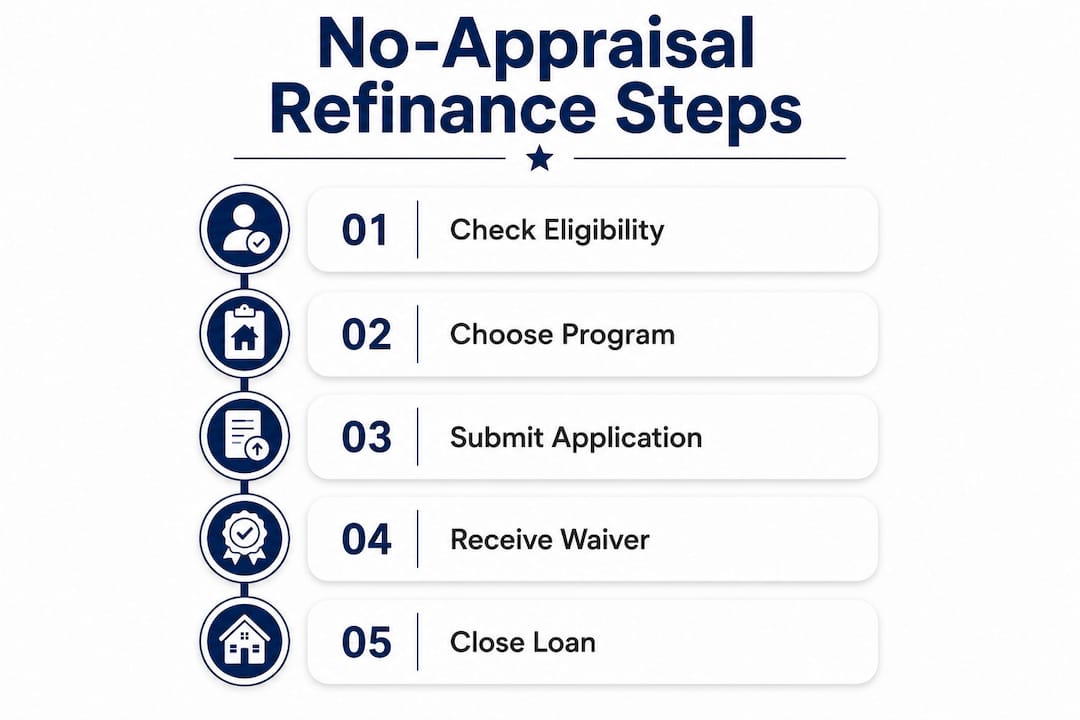
Step-by-step process to apply for a no-appraisal refinance
- Check your current loan type. Confirm whether you have an FHA, VA, USDA, or conventional loan, since your program eligibility starts there.
- Estimate your equity. For conventional waivers, you generally need a minimum of 10% equity. Pull a rough estimate using your current balance and a local market value estimate.
- Contact a loan officer. Ask directly whether your situation qualifies for an appraisal-free path and which program fits best.
- Submit your application. The lender runs your file through the automated underwriting system. For streamline programs, documentation requirements are minimal.
- Wait for the waiver decision. If the system approves a waiver, the appraisal step is removed from your timeline. If not, you decide whether to proceed with a full appraisal or explore other options.
- Review your Loan Estimate. Confirm no appraisal fee is listed and compare the rate and terms against your current loan.
- Close the loan. With no appraisal to schedule, your closing timeline is typically shorter, often by several weeks.
Amerifilending works with Utah homeowners across all of these programs. Explore your refinance loan options or connect with the team at Amerifilending to find out which path fits your situation.

Key Takeaways
Refinancing without an appraisal is achievable through government-backed streamline programs or conventional appraisal waivers, but each path carries specific eligibility requirements and tradeoffs that affect your rate and loan terms.
| Point | Details |
|---|---|
| Three streamline programs skip appraisals | FHA Streamline, VA IRRRL, and USDA Streamline each waive appraisals for eligible borrowers with existing government-backed loans. |
| Conventional waivers need minimum 10% equity | Fannie Mae Desktop Underwriter and Freddie Mac Loan Product Advisor grant waivers when at least 10% equity and data quality thresholds are met. |
| No-appraisal loans may cost more over time | Lenders often price in a small rate premium to offset the risk of skipping physical collateral verification. |
| Lenders can override any waiver | Even when a waiver is issued, lenders retain discretion to order a full appraisal if property data is insufficient or the home is unique. |
| Ask before you apply | Your loan officer can tell you upfront whether your loan type and equity qualify for an appraisal-free refinance. |